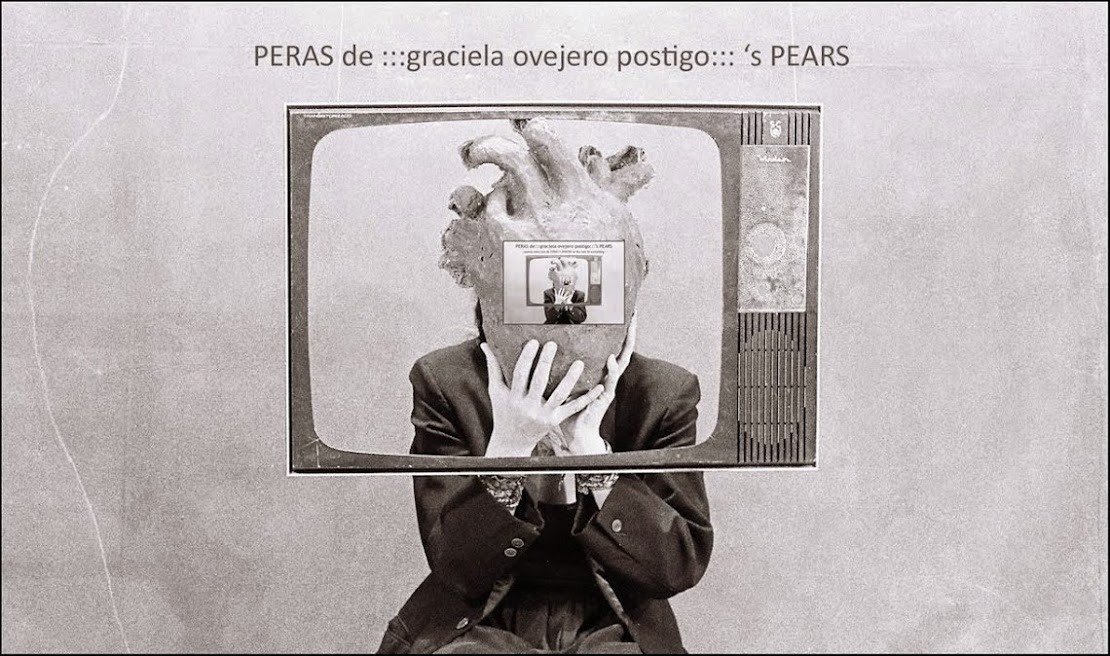

from: | Kekena Corvalán |
to: | graciela ovejero postigo |
date: | Fri, Aug 1, 2014 at 11:00 AM |
subject: | Entrevista / Interview |

That experience helped me to verify the cost that objectual exhibitions imply for the spaces and as I do not do gallery work in the commercial sense because it is not my inclination, nor do I care about it as an added profession at this stage of my life, I realized that I could not sustain that kind of exhibitions in a continuous way, nor the expectations they generate in the artists. During and after that first show, performatic events with contemporary musicians and other artists took place and I began to think of a series of action art as an open laboratory, meetings where I could show works and projects in progress. At the beginning of 2012, in May, I lauched the Series that is now the main one and that identifies us as a space dedicated to performance and action art in a permanent way, although from there we may give place to other productions and exhibition projects concerning performance art: Open field / campo abiertO – Laboratorio de acciones 100xSiento.


So, Peras/ is a autonomously administered and produced space that is fundamentally supported by the availability of my house-laboratory and my organizational work, project by project in agreement with the artists involved. Artists and curators are invited and I follow very closely the processes with them, sometimes combining residencies in the house. The documentation of everything we do is a firm commitment of production by the space and we share it with all artists involved, but we always recommend that they ensure the documentation of their works by their own means as well. The idea is to get along, articulate, exchange in solidarity, work with joy, recognition and mutual learning, with clear codes and loyalties to critical ideas, to what is shared and received, but not to generate dependencies; instead, to generate coming back for more gregarious challenges. My wish is for the space to be a stable reference of excellence for the practice of performance, for artists who identify with it and an open place for those who appreciate its spacial richness and scope as spectators and researchers.


I believe that the spectator who goes to see a performance comes to an appointment with herself/himself, and those who go out of curiosity should know that nothing is casual or superfluous, and that they will have un unforgettable experience. Performance is a multimedia art historically linked to the field of visual arts, but it does not only enter through the eyes, it generates textures and psychic landscapes that we cannot always reduce with judgements and verbal assessments.


To date (August 2014), we have produced 14 volumes of the Open field/ Series among other projects and exhibitions, showing original work by around 72 performers from Argentina, Uruguay, Colombia, Venezuela, Chile, Brazil, Cuba, Costa Rica, Ecuador, France, Norway, USA and South Korea; approximately 44 visual artists and several creators of experimental music, video and experimental film. In November it will be 3 years. I am deeply grateful to all the artists who have been participating.

Peras de Olmo - ARS CONTINUA / PO-AC
https://perasdeolmo.wixsite.com/arscontinua
https://www.youtube.com/channel/UCkEPf5PkgUzkF006ngke4NA
Returning to the name-idea Peras de Olmo and how it came about, supposedly some people, perhaps the wishful, delusional ones or poets “ask for pears from the elm tree”, that is what a certain ‘common sense’ tells us. Some time ago, in my 1st return to Tucumán, where I was born and where the basis of my formation and life took place until I was 29 years old, faced with the experience of the re-dislocation of that return --I had taken myself to California, to experience a different context and cultural distance from the one I new--, I felt the need to conceive and sustain a symbolic, personal 'non-place' that would allow me to resolve, locate and cultivated the heterodoxy of my life. The heterodoxy that was my experience as an artist, already a migrant, of non-conformist and unconvinced generational heritage, except for the responsibility to be suspicious of all conventions that dictate reiterative behaviors of largely oppressive forms and, as a woman, especially self-oppresive ones. This non-place already existed within myself and was in fact also in the collective imaginary suggested in the proverb or popular expressions such as 'peras de olmo', and for the same reason fascinating to me. That place where the elms would give pears or whatever you asked of them, even if it was from an insinuated impossibility and implicit cost. However, that anonymous and popular image of the impossible resonated activating and became functional with respect to the desire, the non-obsequence and the symtomatology perceived in the context of that return.
It was in a kind of eureka moment, in that particular crossroads of my biographical juncture back in 1991 and 92, after 5 years since my departure to California, while I was preparing a solo exhibition in a space of the Museum of Fine Arts of Tucumán, that I thought of "Elm's Peras" as a present and symbolic form of expansive existential power, an image that gave an account of a shift over the real and conventional, about a poetic and political 'be-ing' that does not 'ask' for pears but generates and gives them away, a step ahead of the classic formula of the utopian. The phrase became the name of the show but also a kind of re-foundational iamge in an ontological sense. Thus, the fruits of artistic making would be 'elm's pears', and the phrase as a statement of non-colonizable 'status' to the assumptions and implicitness of art, its 'local moments', genres, and above all in terms of the suggestive tensions of particular circuits of confirmation. Those were the times of the Glusberg's reign with his 'avant-garde' and 'vip' vision of contemporary art and its management; perhaps the 1st model of the curatorial figure that was beginning to take shapo in its new configuration in Argentina, in this case as a kind of principality. [1]
[1]Glusberg Jorge Glusberg (1932-2012) was an Argentine essayist, anthologist and cultural promoter. In 1968 he founded the CEAC (Centro de Estudios de Arte y Comunicación) which in 1969 was renamed CAyC (Centro de Arte y Comunicación). He was director of the National Museum of Fine Arts between 1994 and 2003, author and editor of several books on architecture, design and art, among them "El Arte de Performance" (1986), possibly the first book written and edited in Argentina on performance.

So, when I returned to the country in the early ‘90s --from that moment on I was able to return annually--, I was confronted with what had been left behind, with previously imagined futures and presents, with echoes of generational narratives and utopias devastated by the dictatorship and also by the incipient democracy. The atmosphere among peers (in Tucumán) was one of being scattered, absent or distanced in various ways, among themselves and even with the artistic enveavor in many cases, and the more active within art or other activities were neutral or assimilated to a 'chenge of moment' that implied a defeat and denial or un-pronounceability of the previous revolutionary intentions. Of course, the moment was different, but in my opinion, the way of understanding it was of a fruitless ambiguity, without much attention to detail, perhaps to hide even the pain in so many dimensions inflicted, a hurried or rushed response I would even say "childdish", a form of passivity... in truth it was the infancy of our democracy and those who were in power abused that too.
In an article of the monopolic local newspaper --that knew how to absorb and domesticate many writers of the Tucumán's intelligentsia-- dated April 26, 1992 the following headline was announced: "Peras de Olmo, una muestra plástica del drama cósmico" / "Pears from the Elm, a fine arts exhibition on the cosmic drama" --there is no signature under the note to attribute authorship to such title and article--, it then continued with the following quotation of something I said: "To create is to define, to furrow, to decide, to play. I try to do it situated in the void, the interval, from the simultaneity of multiple possibilities. Why? Because I doubt everything and deep down I hope for the just and the great." I am a little surprised to discover that I have always thought basically the same way.


It is inevitable for me to go over things... We know that historical traumas take a minimum of 3 generations to begin to be addressed, I believe that in our case as a country where one abuse followed another, the Menemist moment --referred to the presidencies of Menem in the 90's --an administration that was totally allied to the Bush's neoliberal politics and only with Kirshner something began to be un blocked. In 1991 the Soviet Union was dismembered, we were witnessing the definitive triumph of capitalism over socialism as projections arising from modernity. The cold war supposedly ended with the fall of the Berlin Wall in 1989, a fact that I experienced in Austria while visiting my younger brother, a cellist and composer who had settled in Vienna, by his own means at age 18, with the ideal of "perfectionism in the original center", a common path that many young artists within westernized world peripheries felt for, certainly a colonial model that imprinted its tensions and pains, even to the more talented.
In the 90's the Latin American utopia, as I perceived then in the country and more specifically in Tucumán, had moved to the frontier and fascination with technology, and /el menemismo fue eso aliado al liberalismo de los Bush y recién con Kirshner algo empezó a destrabarse. En el 91 se desmembraba la Unión Soviética, asistíamos al triunfo definitivo del capitalismo sobre el socialismo como proyecciones surgidas de la modernidad, la guerra fría supuestamente concluía con la caída del muro de Berlín en el 89, hecho que viví en Austria mientras visitaba a mi hermano menor, chelista y compositor que se había instalado en Viena, por sus propios medios con 18 años, con el ideal del "perfeccionismo en el centro original", un camino común por el que muchos jóvenes artistas dentro de las periferias del mundo occidentalizado se sentían atraídos, por supuesto un modelo colonial que imprimía sus tensiones y dolores, incluso a los más talentosos.
In the 90's the Latin American utopia, as I perceived then in the country and more specifically in Tucumán, had moved to the frontier and fascination with technology. There was a collective enchantment with the fiction announced by Menem (the president) that we had entered the 1rst world. The café of the intellectuals and young poets is replaced by the 'Shopping-Mall' model, the proliferation of mini-casinos in peripheral neighborhoods and a new parallel entrepreneurship based on the conviction that the moment allows for quick enrichment, the party and the mafia, the yuppies, the trivialization of everything that was critical thinking. Those were my impressions. The beginning of the era of the "cool", the cooling and distancing of the individualistic consumerist and "brand seeker" subjectivity that trapped the middle class, youth and from there gradually conquered down the desire of the rest of the social strata. That was one of the consequences of globalization, the evangelization of logos and cell phones. In that context, to think of utopias was to go against the grain. In the nineties, the art of Tucumán flamed between pop-under and pop-top, kitsch and self-declared "non-idealistic" conceptualism, assumptions that seemed to have overcome without major traces the "irregularities" and traumas of a decade before.
Perhaps it would be interesting to elaborate a little more on facts and contexts prior to my departure since in many aspects they resonate in synchrony with contents and manifestations investigated and shown in the project “Perder la forma humana / Losing the human form”[2]recently exhibited here in Buenos Aires. A very important research and curatorial project that analyzes at various points certain responses and critical resistances assumed by artists and collectives not aligned to the dominant pulse during the 80's in Latin America without necessarily having a connection or news between them. The context of that exhibition and some of the talks by actors linked to those experiences that I was able to witness were very mobilizing and stimulating as they confirmed a sort of rebellious poetic force in trans-apparent synergy from Argentina to Mexico. In fact, I would say even California, because there, between San Diego and Tijuana, there was a powerful flow of coexistence and artistic production that wielded the experimental and the political, with collectives such as the Border Arts Workshop / Taller de Arte Fronterizo (BAW/TAF), el Lugar del Nopal, Las Comadres and others.
[2]“Perder la forma humana.Una imagen sísmica de los años ochenta en América Latina”/ "Losing the human form. A seismic image of the eighties in Latin America" exphibition organized be the Museo Nacional de Arte Reina Sofía (Madrid) in collaboration with the Museo de la Universidad de Tres de Febrero (Buenos Aires) and the Museo de Arte de Lima with the support of AECID. Curated by: Red de Conceptualismos del Sur(2014).


I left Tucumán for California, landing in San Diego a day before 1985 ended, two weeks after the cancellation of the annual exhibition of Grupo Crónica, the collective of which I was a member. This act of censorship took place the same night of its announced inauguration because certain contents of the works were considered "against morals and good customs" according to the director of the sponsoring institution in a document drawn up at the time. The document was signed by herself and some witnesses from among the spectators who came to see the exhibition, signing witnesses asked for the document to make explicit that they "did not know the character of the works", that is, they did not recognize that they were endorsing an act of censorship and that censorship is the act that prevents the contact of an artistic or testimonial expression, whatever its content or "character", with the rest of society. That report on the cancellation of our exhibition, issued by the director in the heat of the circumstances created by her poor consciousness, becomes an evidence of self-defeat as a public servant of a newly restored democracy and a sad identification with the violence of internalized patriarchy by a woman artist. It is a document of time and place! Tucumán did not stop "burning" [3] since the 1960's.
The immediate post-dictatorship in Tucumán showed us how the mechanisms of repression installed in the citizen psyche were active and ready to find objects of punishment. There is a subsequent story of censorship that also involves the same director of the Cultural Center of the city's Municipality, Nora Castaldo, a lawyer and well-known actress of the milieu,who --I believe-- has held political positions sence then without interruption as a member of the Radical partu --a not at all radical political force in Argentina--. The evento took place the following year 1986, but this time she managed to be on the defensive side representing works of another artist invited by her, who's homoerotic paintings and drawings were presented in a section only accesible to spectators over 18 years old. The exhibition called "El enmascarado no se vence" del artista Sergio Tomatis, generated a heated public dispute between rival political representatives of the country's two major parties: Radicales and Peronistas, the latter manifesting strong rejection to the type of art in the show, labeling it as "apology of homosexuality". A spectacle of aberration of criteria and "ethical" judgments that culminated with the sinister result of the artist having to self-exile and the "laundering" of the director's record as a censurer. These facts were never reflected upon and when in 2007 a revisionist exhibition of the artistic productions of the 70's / 80's in Tucumán called Inscripciones Invisibles (reference links after the images), touched the subject of censorship, but never established this chronological relationship with clarity re-invisibilizing complex facts of political contradictions and speculations, abusing artists realities, in that provincial argentine context in its second and third year of democracy.
[3] A reference to "Tucumán Arde" a famous research, process and media based artistic-political project carried out in 1968 in the city of Rosario and Buenos Aires by artists of the politicized "vanguardia", artists from both mentioned cities, that were close to Instituto Di Tella, a private organization set as a "non-profit cultural research center in the Capital of Argentina. It was founded on July 22, 1958 by the Di Tella Foundation, in honor of the Italian-Argentine engineer and businessman Torcuato Di Tella" (Wikipedia). Today the private Universidad Torcuato Di Tella attempts to recover that avant-garde legacy.


http://www.leedor.com/contenidos/heterodoxia/aire-de-buenos-ayres

Energy, Anger Spice ‘Border’ by LEAH OLLMAN. APRIL 10, 1991
https://www.latimes.com/archives/la-xpm-1991-04-10-ca-110-story.html

Look, in principle as "possible", all 'profiles', both here and there, considering the conditions of accessibility and traffic of ideas and images currently offered by globalized virtuality. In this sense contemporary artists (cognitive class) coexist in multiply worlds, they are children of nobody, or descendants of ideas that move through intermittent currents of fragments of images, which also exhibit precariousness because today everything is precarious, for everyone. But neither ideas nor images in this apparent multipolar chaos of globality participate in the supposed "free will", the theological principle of meritology that tries to make a preconceived (Judeo-Christian) moral will prevail as "ideal", which in any case is understood as a concession of the 'supreme Being' towards the human as the seed or DNA of its creation, to prove its own political and hierarchical narrative. The narrative that has given rise to patriarchy as a civilizing principle, and that continues to generate colonizing empires and genocides. Ideas and images also coexist as almost all "user-consumers" --subjectivities shaped in modern-informational capitalism, or affected by its globality--, with certain deterministic games and buffets of identities, nodes and readymade profiles, of the systemic substratum (algorithms, bots) of power dynamics, which of course generate antidotes, where the questioning creativity of poetry, artistic expressions, or philosophy, generate deconstructive 'substances', by their connection with the perceptual and emotional centers of the body, the gastric juices of the symbolic functions can become very powerful, and in that there could be some hope.
Contemporary art faces something very serious, late capitalism is an omnivorous and penetrating chamaleonic mirror, it has become largely 'in the image and likeness of', it colonizes us by advocating our needs and preferences through an empire of syncretic visualities that iconologize reality in instantly servile prototypes, processes of abstraction indebted to the artistic and visual thought developed since the western avant-gardes of the 20th century. Art / narcissus has been swallowed by the mirror, its "being" comes from outside. All possible configuration of nodes and profiles in the individual dimension would be within reach and susceptible of appropriation through the virtual, technological system of communication and of 'being in the world' today, which is with a cell phone to the body, and the web to the unconscious.

In the cultural and social dimension, temporality assumes conditions that are more opaque, slower, more dependent and conditioned to historical legacies. Attractions are collated and will finally acquire form and matter in the context of specific geopolitical and symbolic territories, although their spacificity has entered into the greatest crisis since the '90s. Within this panorama, the practice of performance and action art have in their constantly reflected specificity the particularity of resisting, for the most part, the seductions of "the society of the spectacle". I have already mentioned that "performance is local and international", the system of production and exhibitions of the practice if fundamentally the responsibility of organizations generated by the artists themselves, an endless number of festivals and encounters. Specific venues in central cities or not, towns and houses attended by artists who cross ll kinds of distances to be present as witnesses and presenters.
Clearly, the most mobile artists are those from richer countries and/or countries where there are governmental or other funds to which they can have access to develop individual projects inside and outside their territories, something that does not exist in our country. This network of exchanges, the one that goes from virtuality to corporeality, is the most decisive in terms of influencing practices. Performance enters though the skin. People begin to make performance from 'seeing', above all in person. There is also the intentional and political line of "responding to", exhibiting from the particular pressures and tensions of a cultural and social history that crosses subjectivity. From this, perhaps we can point out nodes as impulses that inform a way of putting the body and the word, that thematize issues in suspension, or stir up disturbing sedimentations within the discursivity and particular tensions of a country, region, city, neighborhood, social class, gender, sexuality.

Performance works from and into personal biography, the social and the political is also subjetivity, this is a concept that contemporary art owes to feminist thought. It is true that both in reflection and in doing we still ask ourselves the question of whether it is possible to identify "nodes and profiles" geopolitically or regionally speaking, and in particular about 'the Latin American', that which we consider our own, this continues to have enormous value and meanings to develop. Preciselly in the framework of the reconfigurations and mutability of economic power, of transnational capitalism and "financial democracies". I don't have a clear or more descriptive answer to your question: "possible nodes and profiles of performative practice here and there", I would love to know! More or less, that is pprecisely the question that triggered the curatorial invitation plan for this and next year with the Open field / campo abiertO – Laboratorio de acciones 100xSiento series of Peras'.
As I mentioned, the basic idea for ‘Peras de Olmo’ plus ‘ARS CONTINUA’ is that the space-home is a laboratory and an observatory --in the field of contemporary artistic making-thinking-feeling with focus on action art and from there to other thresholds of crossings. And the city of Buenos Aires is for me the ideal location, from personal psicho-geographic issues, its cultural and intellectual magnetism has always been remarkable but in the current times this is evidenced as much more accentuated and the interesting thing is that its current cosmopolitanism is mainly Latin American and remarkably young and informed. New waves of immigration from countries like Colombia or Venezuela --expelled by complex historical and social violence stemming from the malignancies of hyper-capitalist colonialism in its phase of systemic mafias, power as literally exposed cruelty, linked to stalked and/or corrupted gavernments by the same colonial-extractivist logic and an accompanying mutant vassalage--, people who arrive with and education under their belts in search of productive dialogues, postgraduate studies, experiences and challenges. This migratory phenomenon, which oscillates between trauma and resilience, when it manages to open itself up to intersectional analytical critisism, contributes a great deal of creative cultural force. I personally enjoy these diversities in a city that imagined itself umbilically linked to Europe. But I should clarify that as someone who has experienced migration and the racializing and ambiguous scrutiny of foreignness, in my case between Argentina and California, I am not so interested in the comparison "here - there" as an organizing principle, in this case involving the south and the north of the continent, but in a networked search clearly from "here", that is Buenos Aires, and through connections from close to distant ones, into other places where there is evidence of production and commitment to a located practice of performance art in countries, regions, cities of what we call "Latin Amarica" and beyond, because our peoples are part of an wide disporic experience that moves in many directions in search of better horizons.


“Curáte / Curate-heal yourself - Pericón Nacional / Pericón National dance”, urban intervention, LoLas Crónicas: Graciela Ovejero Postigo y Elizabeth Cárdenas. Obelisco, Buenos Aires Argentina. 2005.


Photography: Robert Paredes.


Video en: https://vimeo.com/user1480111/channels


"Buenos Ayres & Ready-Maiden Mind". Solo show BsAs, Barraca Vorticista. 2009


"Regional Product / Producto Regional." Graciela Ovejero Postigo, selfportrait 1997 (for catalogue). Souvenir of Tucumán - Nomadic Anthology of Objects, 2nd. installation of itinerante project. Exhinition "Veredas Argentinas - Argentine Pathways" contemporary Argentine and Californian art 1999. The Latino Museum of History, Art and Culture (1998-2012). Los Angeles, CAMuseo de Historia, Cultura y Arte Latinoamericano. Los Angeles, CA.


_La Gran Bóveda / lo múltiple potencial > lo universal del Dolor / lo universal de la Alegría.


AtAsian Art Archive
Photos, Docs at AAA/Asian Art Archive
https://aaa.org.hk/en/collections/search/search/actors-id:43582
Catalogue from Subjected Culture –Interruptions and resistances on femaleness Argentina 2008.
Curator Graciela Ovejero (Graciela Ovejero Postigo)
http://www.cyman.net/subjected_catalogue.pdf
UPDATE
In June 2022, during my participation in Overlapping Kassel, an international gathering of performance artists organized by Chinese artist Cai Qing in the German city of Kassel, during the opening of DOCUMENTA 15, while visiting the exhibitions at the Friedericianum Museum, one of the first buildings in the world to be designed as a public museum since 1779, and the main building of the big contemporary art event DOCUMENTA, which animates the city every 5 years since 1955, I discovered by pure coincidence that my work realized in the framework of the last Residency of the international collective WOMANIFESTO based in Thailand, was mentioned among the exhibited documentation on WOMANIFESTO's archive, which is part of the Asian Art Archive of Hong Kong since 2020.
